

A long Weekend in France – Part 2
Today’s plan – a circle from Douaumont to Reims and Auberive, after that over Souain-Perthes-lès-Hurlus to Sainte-Menehould. Visit a few more cemeteries and see some French countryside.
Douaumont Ossuary

A memorial built within the Verdun battlefields. It contains more than 130.000 fallen soldiers of the French and German sides. In front of the memorial is a big graveyard with more fallen soldiers. The Battle of Verdun was the longest in human history and lasted 303 days. In 2000, it was estimated that the battle took 714,231 soldiers. Recent estimates go up to 976.000 casualties during the battle, with 1.250.000 suffered at Verdun in the First World War.
When you drive to the monument, you pass trenches and smaller memorials. A whole village that was destroyed and not rebuilt after the war. You drive through a peaceful forest that was planted here in 1930 – still 100.000 missing soldiers under that forest. And every time they find the remains of one, they bring them into the Douaumont Ossuary.

The largest single French military cemetery of the First World War with 16,142 graves.

Muslim part of the grave yard

10 soldiers in one grave


At last, 130.000 soldiers are buried under the building

All of them unidentified combatants of both nations

On September 22nd 1984, the German Chancellor Helmut Kohl (whose father had fought near Verdun) and French President François Mitterrand (who had been taken prisoner nearby in World War II), laid down wreaths in memory of the fallen soldiers. They were holding hands for several minutes in the rain as a gesture of Franco-German reconciliation. And there are some mad monkeys that think Europe is a bad idea! This is the longest time we have had no war with the French. In fact no war at all in the European Union since WW II.

Memorial for the Jewish soldiers

Why could they not ask for a German translation?? Forbidden lawn??

These stones mark the furthest points the Germans reached during the 1918 offensives. This one in La Pompelle was paid for by the Mexican Association of War Veterans. 200 Mexicans fought in this sector!
Fort de Vaux
This was the second fort that fell into German hands after Fort Douaumont.

Flags over Fort Vaux

Memorial for Rayand’s last pigeon

Hospital in Fort Vaux

One of the Canons
Enough of the war for today!
Reims

Coffee break before we hit the city
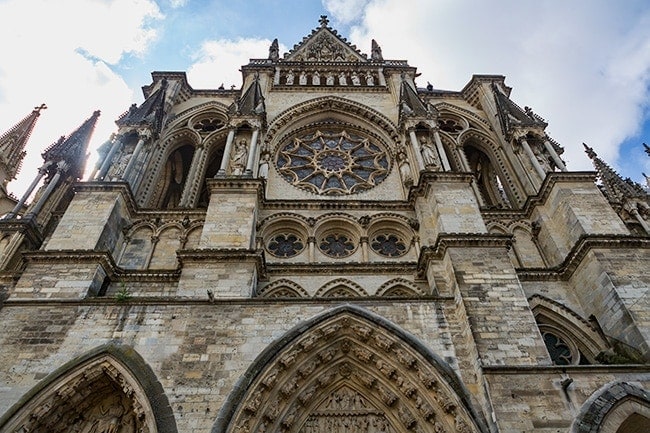
Cathedral Notre Dame in Reims. The first church was build here in 401. In 816 the first King of France was crowned here. After that it was remodel, it burned down and rebuild a few times.

The main entrance in the front

A fire destroyed the towers in 1481

Inside the Cathedral. The 3 windows all the way in the end are designed by Marc Chagall

This is pretty amazing


Public library – one of the many Art Deco buildings in Reims. After the First World War, 80 percent of the city was destroyed. So a lot of buildings were built in the 1020s. I have to go again next year and have a look!

Louis XV in front of the Place Roya

What a nice house

500 years Jeanne D’Arc


The town hall in Reims

Hôtel de Ville, Reims

Detail of the town hall

A horse looks out of a wall

Sube Fountain

A living wall
Auberive

Road in Auberiv

French national cemetery Le Bois du Puits

They put them 6 feet under, head to head, which is quite unusual

5359 German soldiers – 3124 that could not be identified were laid in an ossuary at the end of the graveyard

Book with the names – in case you want to find your great-grandfather


Now it looks quiet and peaceful

The dramatic sky with the clouds made the visit even more intense

Flat land and a wide sky

We drive to the next place
Souain-Perthes-les Hurlus

La Crouée War Cemetery is the name of the French side, with more than 30.000 graves

Souain German War Cemetery is the name of the German side. Under this “Unknown soldiers” memorial are 11320 fallen German soldiers buried


Another 1900 graves on the German side of the graveyard

The Jews got different stones

